
More Than a Prophet: Preparing the Way in the Holy Mass
- Dec 15, 2025
- 9 min read
Most of us spend our days preparing for things that ultimately pass. We prepare for work deadlines, school drop-offs, social events, meals, holidays, retirement. We prepare our homes for guests and our bodies for sleep. Yet a more unsettling question presses quietly beneath the routines of modern life: who prepares the way for God to enter our lives?
Not in an abstract sense, but concretely, on a Sunday morning, after a long week, distracted, tired, perhaps spiritually lukewarm. When we walk into a church carrying the weight of our emails, bills, news headlines, social media posts, and unspoken griefs, who prepares the way for the living God to come to us?
Jesus once spoke words that were both praise and revelation:
“Yes, I tell you, and more than a prophet. This is the one about whom it is written: Behold, I am sending my messenger ahead of you; he will prepare your way before you.”
These words, spoken about Saint John the Baptist, are not frozen in the past. They echo every time the Holy Mass is celebrated. The question is whether we recognise what is happening or whether the most extraordinary preparation in the world unfolds before us while we remain spiritually distracted.
Saint John the Baptist and the Art of Pointing Away from Oneself
In a culture obsessed with self-promotion, Saint John the Baptist is deeply unsettling. He does not cultivate a personal brand. He does not build followers and likes to secure influence. His entire life is reduced to a single gesture: pointing away from himself.
“Behold, the Lamb of God, who takes away the sin of the world.” (John 1:29)
John prepares the way not by becoming the centre, but by removing himself from the centre. This is profoundly counter-cultural, especially in a digital world where identity is curated, broadcast, and monetised. We are trained to draw attention to ourselves, our opinions, our achievements, our suffering, our virtue, our status. John does the opposite. He becomes smaller so that the Other may be seen.
Yet John is not a priest. He does not offer sacrifice. He does not consecrate. He does not place the Lamb into the hands of the people. His task ends at the threshold. He can point, but he cannot give.
This limitation is not a failure; it is his vocation. He stands at the edge of fulfilment, announcing what is coming but never possessing it sacramentally. John prepares the way, but the way leads beyond him.
In our daily lives, we often live permanently at this threshold. We speak about faith, read about faith, argue about faith, even admire holiness from a distance. But preparation is not the same as encounter. John’s life raises a disturbing question for all of us: are we content merely to point, or do we allow ourselves to receive?
“Go and Tell John What You Hear and See”: Signs of the Kingdom in the Holy Mass
When Jesus responds to the disciples of Saint John the Baptist, he does something unexpected. He does not offer an abstract theological explanation. He does not defend his authority with argument. Instead, he points to what is happening:
“Go and tell John what you hear and see: the blind regain their sight, the lame walk, lepers are cleansed, the deaf hear, the dead are raised, and the poor have the good news proclaimed to them. And blessed is the one who takes no offence at me.”
At first glance, these words appear to describe only physical miracles. Yet Jesus is revealing something far deeper: the arrival of the Kingdom is recognised by transformation, not spectacle. Where the Messiah is truly present, creation begins to heal.
This is precisely what the Catholic Mass claims to be.
In a modern world trained to measure reality only by what can be quantified, this list can easily be dismissed as symbolic or exaggerated. Yet the Church has always understood these signs sacramentally. In the Holy Mass, the blind do not always receive physical sight, but faith itself is restored. The lame may not leave the church walking differently, but souls paralysed by sin are strengthened. Lepers are cleansed not in their skin, but in their conscience. The deaf begin to hear not merely sound, but the Word of God addressed personally to them.
Most striking of all is the raising of the dead. Every time a person in mortal sin is reconciled, every time grace returns to a soul that had grown cold, the dead are raised. These are not metaphors invented after the fact; they are the living reality of the sacramental life.
And then there are the poor.
In the Holy Mass, the poor are not defined primarily by economics, but by dependence. Those who know they need God's mercy, those who arrive empty-handed, those who recognise that they cannot save themselves, these are the ones to whom the Good News is proclaimed most clearly. The Holy Eucharist does not reward spiritual achievement, it feeds spiritual hunger.
Jesus ends with a warning that is easy to overlook:
“Blessed is the one who takes no offence at me.”
This is perhaps the most confronting line of all. God does not arrive in ways that flatter human expectations. He comes hidden, quiet, vulnerable, under the appearance of bread, entrusted to the hands of ordinary men, offered in an unremarkable parish on an ordinary day.
Many are not offended by Christ’s words, but by his humility. The Holy Mass demands a faith willing to accept that God works through what appears small, repetitive, and unimpressive.
“More Than a Prophet”: What Changes in the Holy Mass?
When Jesus says that John is “more than a prophet,” he immediately adds something even more startling:
“Yet the least in the kingdom of heaven is greater than he.”
This is not about moral superiority or spiritual ego. It is about access.
The kingdom of heaven is not simply a future destination; it is a sacramental reality made present. What John could announce, the Church now handles. What John could see from afar, we now receive upon our tongues.
This is where the Catholic Mass changes everything.
The priest is not simply another preacher adding commentary to the Holy Scripture. He speaks as Christ himself, lending his voice, hands, and person to the eternal High Priest. At the altar, he acts in persona Christi. When he speaks the words of consecration, Christ himself acts through him. The sacrifice of Calvary is not repeated, but made present. Time collapses. Heaven bends towards earth.
In the modern world, we are accustomed to symbolic gestures without real substance. Words are often empty. Promises are fragile. Even authority is treated with suspicion. Yet the Holy Mass quietly contradicts this scepticism. Here, words do what they say. Bread becomes Body; Wine becomes Blood.
The priest is not merely a prophet who speaks about God. He is a priest who stands at the intersection of heaven and earth. The prophet announces the Word of God, the priest makes the Word sacramentally present. The prophet points towards salvation, the priest administers its sacramental means. The priest is “more than a prophet” not because he replaces prophecy, but because he embodies its fulfilment within the sacramental order. This is why the Holy Mass cannot be reduced to community gathering or inspirational ritual. Something objectively happens, regardless of how we feel.
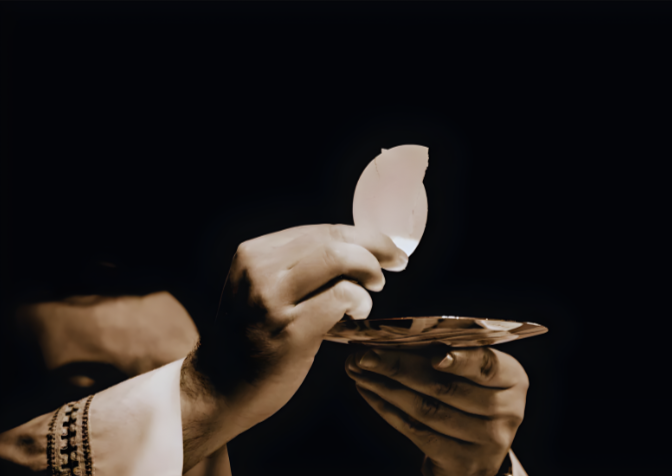
Just before Holy Communion, something extraordinary happens, so familiar that it is often unnoticed. The priest lifts the consecrated Host and says:
“Behold, the Lamb of God, who takes away the sin of the world.” (John 1:29)
These are not poetic words chosen for atmosphere. They are the words of Saint John the Baptist. At this precise moment, the priest steps into Saint John’s role, not symbolically, but liturgically.
In a society overwhelmed by constant noise, this moment is almost offensively quiet. No spectacle. No emotional manipulation. Just a Sacred Host, raised silently, while heaven waits.
Yet there is a decisive difference. John pointed to Christ walking along the Jordan, the priest points to Christ resting upon the altar. John announced the Lamb who would take away the sins of the world, the priest presents the Lamb who has done so. In this sense, the priest unites within himself the roles of prophet and priest, herald and sacrificer. He prepares the way not only by preaching repentance, but by sacramentally opening access to God himself.
Thus, within the Holy Mass, the priest embodies the fulfilment of prophecy, the reality of sacrifice, and the immediacy of salvation. He is not greater than Saint John the Baptist by personal merit, but by sacramental participation in the priesthood of Christ.
Preparing the Way in the Liturgy
The entire structure of the Holy Mass can be understood as a preparation of the way of the Lord, culminating in Holy Communion.
The Introductory Rites calls us to repentance and dispossession of sin, echoing John’s call to conversion. The Liturgy of the Word proclaims the Holy Gospel, making Christ present in his spoken Word. The Homily interprets this Word for the present moment, preparing our hearts and minds for sacramental encounter.
The Liturgy of the Eucharist then brings this preparation to its climax. The priest offers the sacrifice of Christ, not symbolically but truly. Bread and wine become the Body and Blood of the Lord. The way is prepared not merely intellectually or morally, but ontologically.
And finally comes the procession. In the Communion Rite, one by one, we leave our pews and walk forward in an ordered and reverent manner. This physical movement is itself symbolic: the people of God advance towards the Lamb whom the priest has pointed out. The queue for Holy Communion is not a practical necessity alone; it is a liturgical pilgrimage, a bodily enactment of the soul’s approach to God. This movement is not merely practical. It is existential. It is the human response to divine invitation.
In this moment, the priest stands at the threshold, mediating access to the sacramental presence of Christ. He prepares the way by ensuring the integrity of the sacrament and the readiness of the communicants.
In our daily lives, we queue for many things—coffee, appointments, entertainment, promotions, etc. Rarely do we reflect on what we are moving towards. In the Holy Mass, the direction of our bodies reveals the direction of our souls.
The priest prepares the way. Not by force, not by persuasion, but by faithful obedience to what he has received. He stands where John stood, but he does what John could not: he gives the Lamb.
This raises a challenging question for us modern Catholics: do we recognise who stands before us at that moment, or have our eyes grown accustomed to the mystery?
Preparation, Distraction, and Conversion in Ordinary Life
One of the great spiritual dangers of modern life is distraction disguised as busyness. We are rarely hostile to God; we are simply preoccupied. The Holy Mass, however, interrupts this pattern. It demands preparation, not only liturgical, but interior.
Saint John called people to repentance because unrepented hearts cannot recognise the Lamb. The priest continues this work, beginning the Holy Mass with a call to acknowledge our sins. This is not a ritual of guilt, but of clarity. It clears the path.
In our daily lives, we know this instinctively. We clean our homes before important guests arrive. We prepare ourselves for serious conversations. We silence our phones for moments that matter. Yet how often do we arrive at the Holy Mass unprepared, expecting God to adjust to our cluttered interior world?
The preparation of the way is not only the priest’s task. It is ours. The priest prepares the altar; we prepare our hearts. Without this cooperation, the miracle still occurs, but it passes us by like sunlight through closed curtains.
The Holy Mass invites us to a deeper conversion, not dramatic, but consistent. A conversion of attention. A conversion of expectation. A conversion of desire. A true conversion of our heart and soul.
The question that lingers is uncomfortable but necessary: what would change in our daily lives if we truly believe that we are receiving God himself?
Are We Still Waiting for What Has Already Come?
Many people today speak as though salvation were always just over the horizon, something future, distant, or abstract. Yet the tragedy is not that God has not come.
It is that we continue to live as though he has not.
Saint John prepared the way for the Lord. The priest continues this preparation daily in every Mass. The Lamb is no longer coming; he is here. The kingdom is no longer announced; it is given.
And yet, familiarity breeds a dangerous indifference.
This is not an argument to be won, but an invitation to be received. It asks whether we approach the Holy Mass as routine or revelation, as obligation or encounter. It challenges us to consider whether our daily lives reflect what we claim to believe.
If the priest truly stands in the place of Christ and speaks with the voice of Saint John the Baptist, then the Holy Mass is not one activity among many. It is the axis around which everything else should turn.
The final question, then, is deeply personal and quietly urgent:
If God is prepared to come to you everyday, what are you doing to prepare for him?
Take time to reflect. Share your thoughts. Engage in the conversation. And above all, allow this question to lead not only to comments on a blog, but to a deeper conversion of life.


Thank for this thoughtful and insightful post