
Advent in the Desert: A Journey of Repentance and Hope
- Dec 9, 2025
- 7 min read
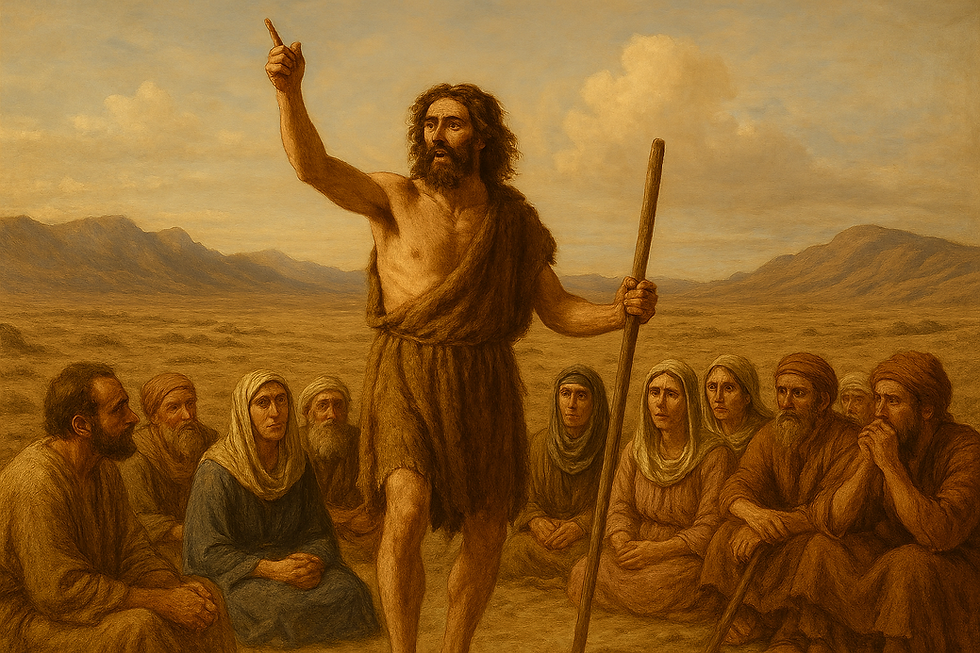
We live in a season where everything feels urgent: shopping lists, school concerts, office parties, end-of-year deadlines, travel plans, family gatherings. Advent often slips through the fingers as if it were simply a countdown to Christmas Day. But Advent is not merely calendar time; it is sacred time. And Saint John the Baptist stands in the desert as a friend to your soul and mine, calling us back to what matters most. If we let him, he will teach us how to reclaim Advent, to detach from the world’s fever, to repent in hope, and to allow Christ’s gentle winnowing to purify our hearts.
Let us walk slowly and talk honestly.
Come With Me Into the Desert: Detachment in a Busy Advent
Imagine the desert. The sky stretches out like a prayer. The earth is bare. The wind is clean. There are no neon lights, no queue at the checkout, no inbox to clear. That is where Saint John preached because the desert reveals: it takes away what is unnecessary so that the necessary can be seen.
You and I need this desert now. Not necessarily a literal desert, but a desert of the heart, a chosen simplicity, a clearing of space for God. Detachment has a bad reputation; it sounds cold or severe. But true Christian detachment is warmth and freedom. It is the reordering of love, which says: God first, and everything else in its proper place. We do not despise created things; we let them serve their purpose rather than enslave us.
Saint Augustine puts it plainly:
You have made us for Yourself, O Lord, and our heart is restless until it rests in You.
When Advent is swallowed by consumer urgency, the heart grows restless, bristling with wants that never satisfy. Detachment restores rest, not by stripping life of beauty, but by recognising that beauty flows from God and leads back to God.
This Advent, as you scan for sales or plan menus, hear John’s desert whisper: “Step aside from the noise. A little silence. A little prayer. A little space.” Perhaps you can claim five minutes at dawn or a quiet walk at night. Perhaps, in the midst of wrapping gifts, you pause between each ribbon to say: “Come, Lord Jesus” (Revelation 22:20). Each small act of detachment is a turning of the soul toward Bethlehem.
Saint Teresa of Ávila once wrote:
Let nothing disturb you, let nothing frighten you; all things are passing; God never changes.
Advent is a season of holy passing—the world hurries, but God remains. The desert invites us to remember this and to breathe.
Repentance: Making Straight His Paths—Change of Mind, Change of Life
John’s cry is not condemnation; it is invitation. “Repent, for the kingdom of heaven is at hand” (Matthew 3:2). Repentance is not a bleak word; it is a liberating one. In Scripture, to repent (metanoia) means a change of mind and heart, a new direction, a rediscovery of God’s gaze upon us. It is not just feeling sorry; it is turning the steering wheel of our soul back towards the light.
Think about the roads in your life. Are there crooked paths—resentments, addictions, anxious needs to control, neglected prayer, habits of distraction? Advent asks us to “make straight His paths” (Mark 1:3; Luke 3:4). Repentance is spiritual roadwork. Where pride has built speed bumps, humility levels them. Where self-interest has carved detours, charity redirects the route. Where fear has blocked the bridge, faith opens it again.
Saint Paul urges,
Do not be conformed to this world, but be transformed by the renewal of your mind (Romans 12:2).
Renewal of mind is not abstract; it happens in our ordinary choices. This Advent, let us repent by choosing patience in the queue, gentleness when we are tired, generosity when it inconveniences us, prayer when we feel empty, confession when sin has become a familiar friend.
Saint John Chrysostom encourages us:
Repentance is a medicine which destroys sin; it is a gift from heaven.
We can feel that medicine burn a little as it heals. But it is sweet in the end. If you have been away from the Sacrament of Reconciliation, consider this your invitation. Advent is the perfect moment to step into God’s mercy:
If we confess our sins, He is faithful and just, and will forgive us our sins and cleanse us from all unrighteousness (1 John 1:9).
Let repentance be practical:
• Replace ten minutes of social media scrolling with ten minutes of faith-filled blogs or the Holy Scripture—perhaps the Gospel passages about Saint John (Matthew 3:1–12; Luke 3:1–18);
• Before a party, ask God for the grace to be a quiet presence of kindness;
• When anger rises, breathe the Holy Name: “Jesus;”
• If you must shop, shop like a Christian—not to fill a void, but to bless others, remembering the poor (Matthew 25:35–40).
Repentance is not a seasonal guilt trip; it is a joyful reorientation. It clears the way for Christ to walk into our lives.
The Winnowing Fan: Purification, Discernment, and Freedom
Saint John prophesies of Christ: “His winnowing fan is in His hand, and He will clear His threshing floor, and gather His wheat into the barn, but the chaff He will burn with unquenchable fire” (Matthew 3:12; Luke 3:17). The image is vivid: grain is thrown up; the wind separates the nourishing wheat from the husks. The point is not destruction; it is distinction. Christ purifies what is good; He discards what is empty. The winnowing fan is the gentle, persistent work of the Holy Spirit in our soul.
What is the wheat in our lives? What is the chaff? On busy December days, the line blurs. The party itself may be the wheat—community, celebration, gratitude. But the vanity that seeks to impress may be the chaff. Shopping can be the wheat—generosity, thoughtful giving. But the compulsion to acquire more, or the envy that compares gifts, is the chaff. Work is a wheat—service, vocation, responsibility. But the self-worth tied to productivity, the neglect of rest or family, is a chaff. The winnowing fan calls us to discern.
Saint Catherine of Siena wrote:
Be who God meant you to be, and you will set the world on fire.
That fire is not the burning of wheat but the burning away of chaff. Holiness is clarity: knowing what belongs to God and letting it be free to flourish.
How does Christ wield the winnowing fan for us?
• Through Scripture, which cuts like a sharp sword, not to harm but to heal (Hebrews 4:12).l;
• Through prayerful silence, where the Spirit’s breeze separates noise from truth;
• Through confession, where the chaff is named and surrendered;
• Through charity, which purifies motives by turning the heart outward in love;
• Through suffering, which often becomes a mysterious wind that loosens our grip on what is not essential;
Saint Francis de Sales encourages gentleness in purification:
Do not lose your inner peace for anything whatsoever, even if your whole world seems upset.
The winnowing can feel unsettling; things we thought we needed drift away. But inner peace is the sign of genuine purification: Christ does not take away what makes us truly live; He takes away what hinders life.
This Advent, invite the winnowing fan:
• Keep a small journal: on one side, write “wheat” (what draws me closer to God); on the other, “chaff” (what distracts or disorients me).
• After events (shopping, gatherings, travel) ask: “What felt like grace? What felt like empty habit?”
• Make one intentional choice each day to burn a piece of chaff: delete an app that constantly distracts, reconcile with someone, give away an item you cling to, skip a needless purchase and donate instead.
Purification is not about moral superiority; it is about freedom. The more chaff is carried away, the more the soul moves lightly, like wheat gathered into Christ’s barn.
Advent as Interior Renewal: Preparing a Place for our Lord Jesus
Advent is not a season of mere anticipation; it is a summon to transformation. It asks us to pause and question: What are we truly preparing for? Is it only the glitter of lights, the perfection of menus, and the exchange of gifts? Or is it the coming of the One who alone can satisfy the hunger of the human heart? “The Lord is near” (Philippians 4:5), nearer than the next breath, nearer than the next sunrise. And because He is near, our preparation must go beyond the surface. It must reach the depths.
This is the moment to rethink our priorities. The world tells us that Advent is about adding—adding decorations, adding events, adding obligations. But the Gospel whispers that Advent is about subtracting—removing what clutters the soul, clearing the inn so there is room for Christ. “Be still, and know that I am God” (Psalm 46:10). Stillness is not laziness; it is courage, the courage to resist the tyranny of noise and to choose what matters eternally.
Saint Bernard of Clairvaux reminds us that Christ comes in three ways: in history at Bethlehem, in mystery through grace, and in majesty at the end of time. Advent holds all three. We remember His birth, we welcome His presence now, and we await His return. But here is the question that pierces through the tinsel and the rush: When He comes, will He find room in your heart? Or will the inn be full—crowded with pride, resentment, consumer frenzy, and endless distractions?
Repentance is not a seasonal ritual; it is a radical reorientation of life. It means asking hard questions: What path needs straightening? What attachment needs loosening? What habit needs breaking? It means daring to believe that holiness is possible, not by our strength, but by grace.
Create in me a clean heart, O God, and renew a right spirit within me (Psalm 51:10).
This prayer is the heartbeat of Advent.
So let this season be different. Let it be quieter, deeper, truer. Let it be the year you prepare not just a home for guests, but a home for God. Step into the desert of the heart. Embrace silence. Seek confession. Practice charity. Burn away the chaff of vanity and excess. And when Christmas dawns, it will not simply mark an event in history; it will mark a transformation in you. A heart renewed, a life redirected, a soul ablaze with the light of the Emmanuel (God with us).


Comments